Before the California Roll, There Was the Street: Tracing Edomae Sushi From Edo's Food Carts to Your Friday Night Takeout
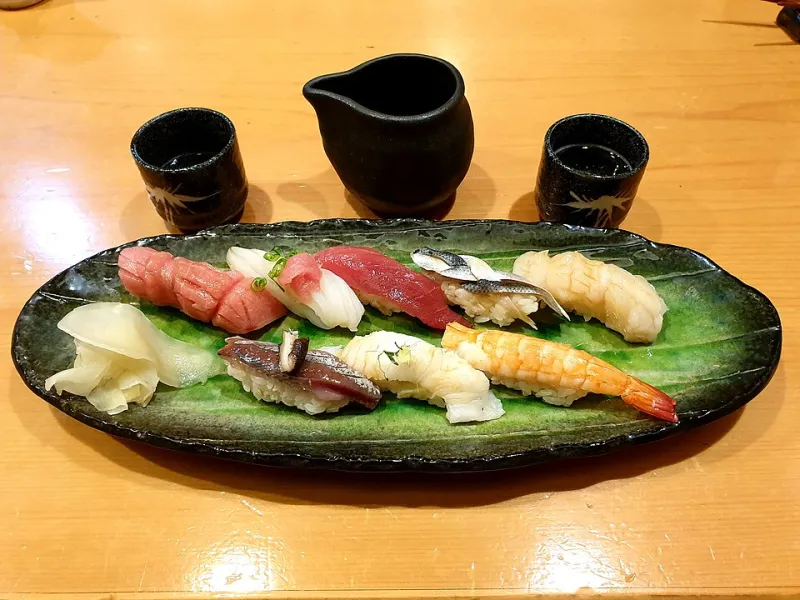
Photo: Emma Brick, CC BY-SA 4.0, via Wikimedia Commons
Here's a sentence that would confuse a samurai: your spicy tuna roll is a direct descendant of Edo-period street food.
It's true, and the detour it took to get there — from wooden food carts in 1820s Tokyo through postwar Los Angeles — is one of the great stories in food history. And understanding it changes how you read a sushi menu. So let's rewind.
Edo: A City That Ate Fast
In the early 1800s, Edo (modern Tokyo) was the largest city on Earth, packed with merchants, samurai on stipend, and a famously itchy trigger finger for anything new. The phrase Edokko — a true Edo native — described someone who spent money like water and never worried about tomorrow. Street food was made for exactly this person.
Enter the yatai: wheeled stalls lit by lanterns, serving quick, hot, cheap food. Sushi in this era wasn't the delicate art piece you see today. It was fast food, literally — nigiri pressed by hand, bigger than modern portions, sold standing up, eaten in minutes. The name for the style, Edomae, simply meant "in front of Edo" — the fish caught in Tokyo Bay, the closest water.
And here's the detail most people miss: Edomae sushi was fundamentally a preservation technology. Refrigeration didn't exist. So vendors leaned hard on vinegar, salt, soy, and kohada that had been pickled for days. The tangy rice wasn't a flavor aesthetic — it was food safety. When you taste that sharp vinegar bite in an Edomae-style piece of mackerel today, you're tasting a solution to a problem that no longer exists, kept alive purely because it's delicious.
The Great Migration
The 1923 earthquake destroyed Tokyo's yatai culture almost overnight, pushing sushi indoors into the counter format we know now. But the bigger migration was geographic.
Post-World War II, Japanese immigrants brought sushi to the US — and it hit the same wall every immigrant cuisine hits: American ingredients, American palates, American skepticism about raw fish. Los Angeles in the 1960s and 70s became the accidental laboratory. The avocado, a fruit with the fatty mouthfeel of toro, became the great translator. And in 1970s LA, the California roll — crab, avocado, cucumber, rice on the outside — did something genuinely clever: it hid the seaweed from suspicious customers and offered cooked-ish ingredients as a gateway drug.
"The California roll gets dismissed as inauthentic, but I think that's backwards," says Kenji Morita, a second-generation sushi chef in Seattle. "It's doing exactly what Edomae vendors did — using what's local, preserving what needs preserving, feeding the customer in front of you. The roll is just the new Tokyo Bay."
A Quick Timeline
- 1820s: Nigiri sushi appears at Edo street stalls; Edomae style is born as fast food
- 1923: The Great Kanto earthquake ends the yatai era; sushi moves indoors
- 1966: Kawafuku restaurant opens in Little Tokyo, LA, among the first US sushi bars
- 1970s: The California roll debuts in Los Angeles; rice-outside rolls follow
- 1980s–90s: Sushi goes mainstream in America; spicy tuna and fusion rolls proliferate
- Today: Edomae revival counters in the US re-embrace curing, aging, and restraint
So What Is 'Authentic,' Anyway?
Spend enough evenings at US sushi counters and you'll hear authenticity invoked like a weapon — usually against avocado, sometimes against anyone who eats wasabi in their soy sauce (a hill I'd gently advise against dying on).
But the history argues for something looser. Edomae sushi itself was an innovation — nigiri didn't exist before the 1820s. Sushi is a 200-year chain of people adapting technique to whatever the water, the market, and the customer gave them. Authenticity isn't a recipe frozen in amber. It's the posture: respect the ingredient, season with intent, don't waste.
Chef Morita puts it plainly: "When a customer orders omakase from me, they're not buying 1820. They're buying my judgment, today. That judgment has Edo in it. It also has California in it. That's not a compromise. That's the tradition."
So next Friday, when the roll arrives, eat it knowing what it is: street food that survived an earthquake, crossed an ocean, and learned a new language — without ever forgetting the vinegar.