The Tip Line Is Not the Point: What Omakase Chefs Wish You'd Leave Behind Instead
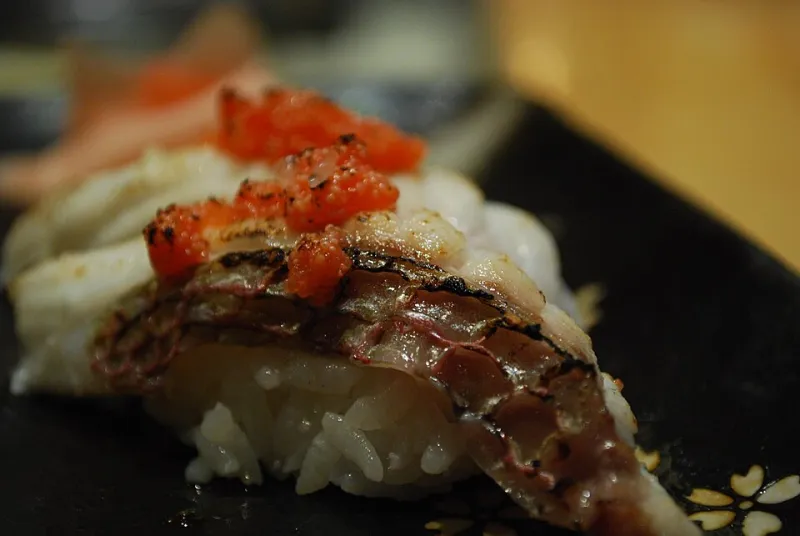
Photo: Alpha from Melbourne, Australia, CC BY-SA 2.0, via Wikimedia Commons
The check arrives in a small lacquered tray, folded once, the way it does at any restaurant trying to be discreet about money. You open it. The seat was $385. Below the total, three boxes: 20%, 25%, 30%. And a little line for "custom."
There's a specific silence that follows. You have just spent almost four hundred dollars on twenty pieces of fish and a bowl of soup, and the tray is now asking you a follow-up question. Do you round up? Do you go for the middle box because the outer two look like a plea? Do you write "service included?" on the line and hope the server knows?
I've been in that silence more times than I'd like to admit, and I've started asking chefs about it directly. The answers are not what the credit card terminal would have you believe.
The Awkward Math of a Very Expensive Seat
Here's the thing nobody prints on the menu: a gratuity on a $400 ticket is a strange instrument. Your server at a mid-priced restaurant might run eight tables a night and depends on 20% to make rent. At a twelve-seat omakase counter, the person who shaped your rice and portioned your uni is usually the owner, and the check is already priced to support the room — the fish, the apprentice, the vinegar, the 4 a.m. market texts.
"People think the tip is the compliment," Ren, an itamae at a twelve-seat counter in Chicago, told me. "But if I get a twenty-two percent tip and never see you again, I made a hundred dollars and lost a seat I could have sold in March."
That's not a complaint about generosity. It's a complaint about what generosity is being pointed at. A one-time gratuity is a lovely gesture and a negligible force in the economics of a counter that survives on repeat business, word of mouth, and a reservation book that doesn't have holes in it.
What the House Actually Sees
American omakase in 2026 mostly runs three ways, and the difference matters before you start doing percentage math in your head.
Service included. An increasing number of high-end counters fold gratuity into the seat price. You'll see language like "pricing includes hospitality" or "no additional gratuity expected." Take them at their word. Writing 20% into the custom line here doesn't make you a hero; it makes the bookkeeping strange and quietly signals you didn't read the menu.
Service charge, distinct from tip. Some houses add a fixed percentage that goes to the house — kitchen, dish, the person who washed your sake cup — and not to the front of the room. Ask once, politely, before service starts, or read the website. It's not rude to want to know where money goes.
The old-school tip line. Still common, still real. In these rooms, the tip is doing actual labor, and skipping it because "the meal was already expensive" is a decision with consequences for people who aren't the chef.
That last point is the one chefs keep bringing up to me, unprompted. Every itamae I've asked about this has said some version of: I'm fine, honestly — but the person pouring your water isn't.
The Tip You Can't Swipe
So what do chefs actually want? When I asked Ren what a great guest leaves behind, he didn't say cash. He said: "February."
That's the answer in one word. February is when the reservation book goes soft, when the holidays are a memory, when the fish is beautiful and the room is half full. A regular who books a Tuesday in February is worth more to a counter than a stranger who tips 30% on a Saturday in December and posts the receipt.
Other things chefs mentioned, in roughly the order they came up:
- Cancelling early. A released seat three days out is often rebookable. A no-show at 6:55 is a $400 hole and a wasted piece of aging fish.
- Sitting at the counter. If you booked the counter, sit at the counter. The corner table with your phone out is a different restaurant.
- Ordering the thing you don't recognize. The sardine. The knotted kelp. The piece the chef is quietly proud of. Eating it is the whole point.
- Coming back. Twice a year beats once with a big tip. Every chef said some version of this.
- Bringing someone who's curious. One convert is worth three Instagram posts.
What the Second Visit Buys
There is a category of diner who treats the gratuity as a lever — tip big, get remembered, get the good stuff next time. It doesn't really work that way, and chefs are gently tired of it. The guest who gets the extra piece of toro is usually the one who came in November, sat quietly, ate everything, said thank you on the way out, and booked again for January.
Trust is the currency. Cash is a courtesy layered on top.
A Practical Etiquette Guide for 2026
- Read the reservation confirmation twice. Service-included language is usually right there, and it's usually ignored.
- Ask about the service charge once, before service. Not during the third course.
- If gratuity is expected, tip on the full seat price, not the post-tax number, and not the sake you brought. Default 20% is fine. Nobody is counting your boxes.
- Cash in a small envelope is welcome at counters where the tip line feels performative — hand it to whoever handled the check, not the chef mid-slice.
- Don't announce it. The theater of generosity is the opposite of omakase.
- If you can only do one generous thing, make it the booking behavior. Show up. Cancel early. Come back.
The Last Word, From the Other Side of the Counter
None of this is an argument for tipping less. If the house expects gratuity, tip properly, and don't use the chef's romantic indifference to money as cover for stiffing the floor staff.
But it is an argument for recalibrating what you think you're doing when you scribble a number in a box. You're not buying a relationship with that number. You're settling a bill. The relationship is built on the calendar, the second visit, the piece you didn't recognize and ate anyway.
Ren put it better, and more briefly, as he wiped down the counter at the end of the night: "The tip is the end of the conversation. I'd rather you keep talking to me."